Education voucher at hand? Step into the fast lane: Contact us
Contact us
DelaySense – Transit Intelligence System
DelaySense is a machine-learning-powered transit intelligence system designed to identify London Underground arrivals that are likely to become delayed within the next few minutes. While conventional passenger information systems show when a train is currently expected to arrive, they offer limited insight into whether that prediction is becoming increasingly unreliable. DelaySense addresses this gap by turning live arrival data into proactive delay-risk information. The system collects real-time arrival predictions from the Transport for London API and stores successive observations to capture how individual arrivals evolve over time. These observations are transformed into time-aware features, including rolling statistics, historical baselines, temporal information and deviations from typical arrival behaviour.
An important part of the project was reframing the task from conventional classification to forecasting. Instead of determining whether an arrival is delayed at the present moment, DelaySense estimates the probability that it will become delayed at a future prediction horizon. This helps avoid data leakage and makes the resulting predictions more realistic and operationally useful. Several machine-learning approaches were explored, including logistic regression, random forest, XGBoost and LightGBM. The final system uses a LightGBM model with a five-minute forecasting horizon.
DelaySense was developed as a complete machine-learning product rather than only a modelling experiment. A FastAPI backend handles predictions and monitoring, while an interactive Streamlit dashboard displays delay probabilities, prioritised arrivals, trends and explanations. The result is an end-to-end system that transforms raw transit data into actionable early-warning intelligence.
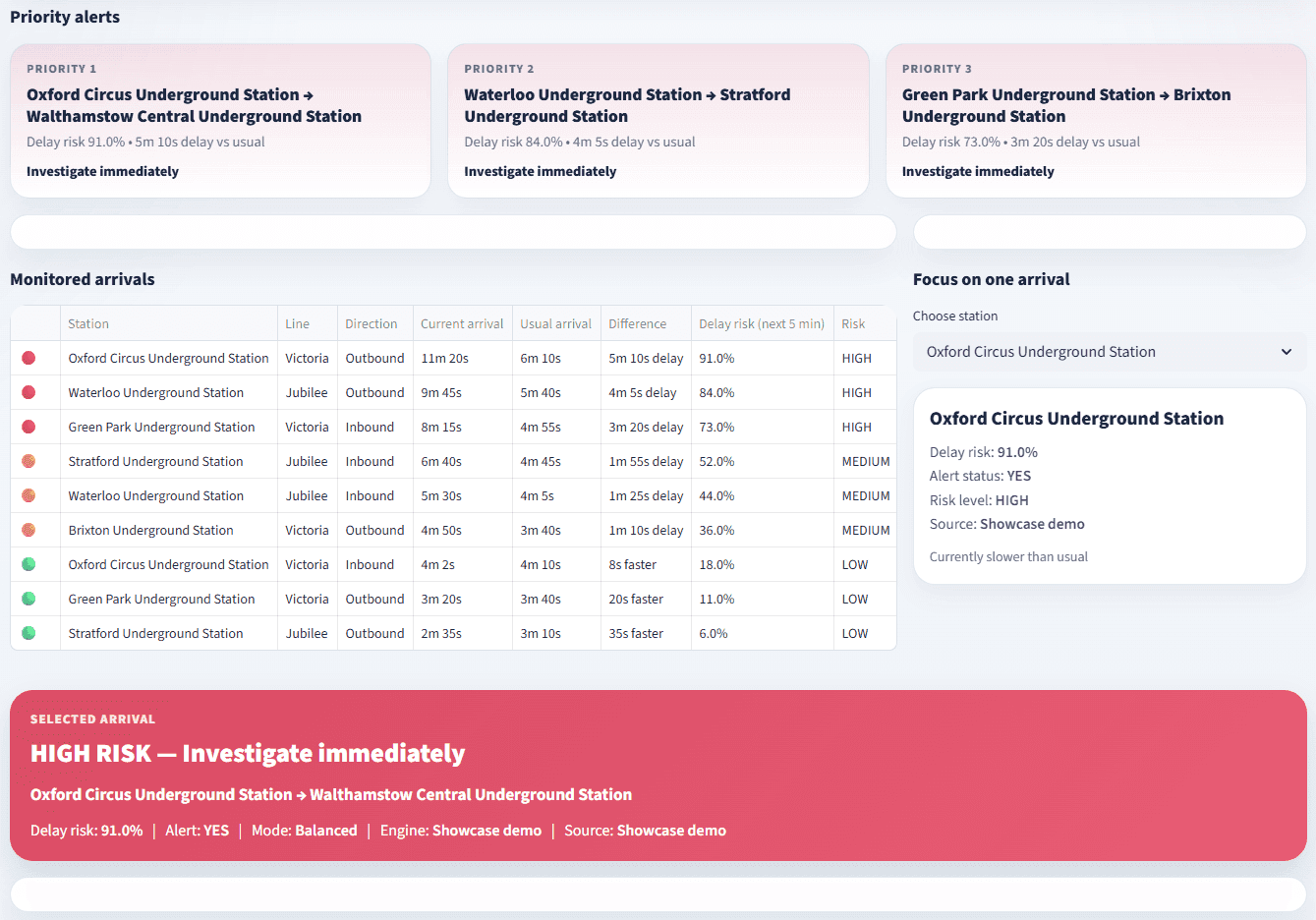
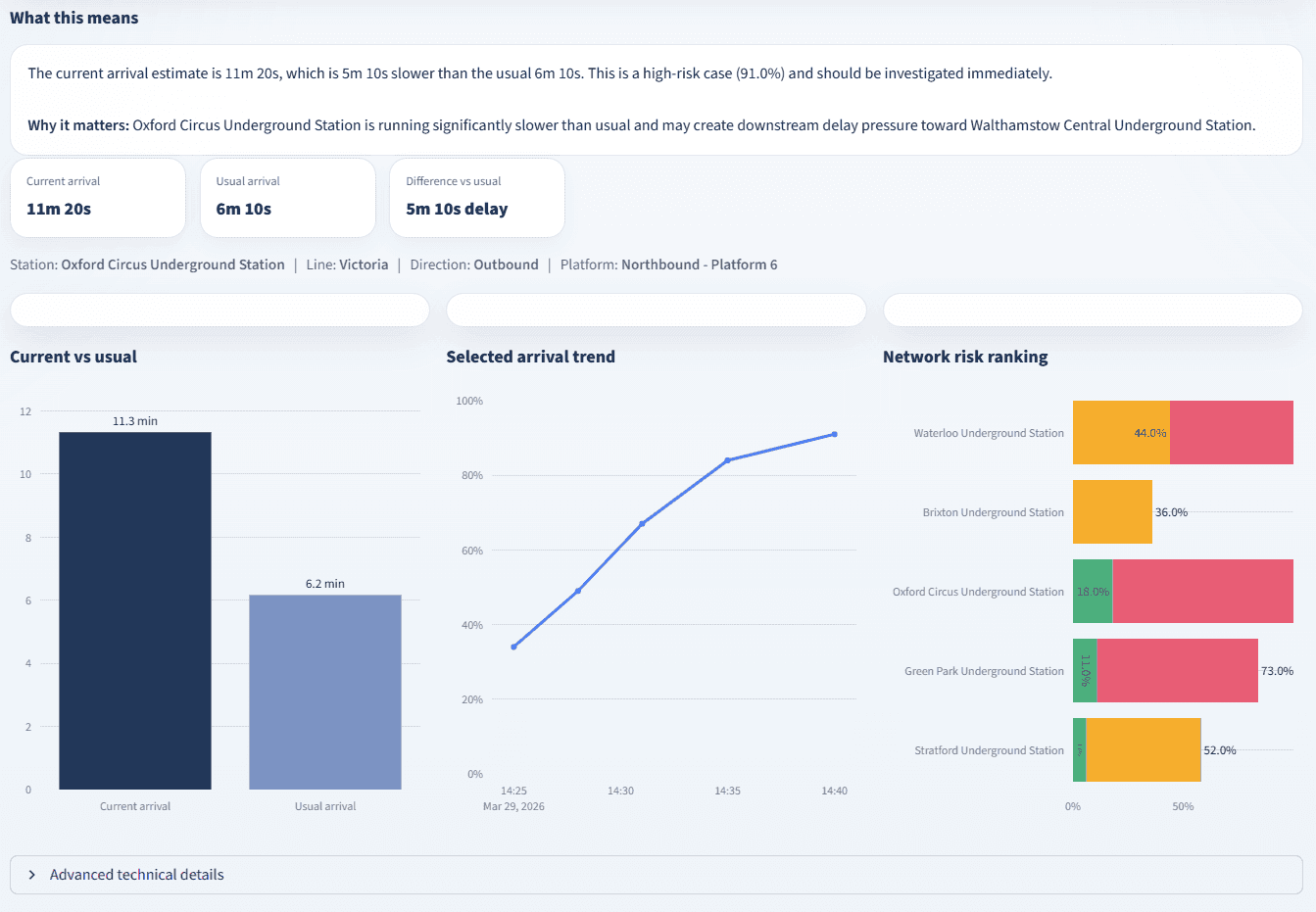
The goal of DelaySense was to evolve beyond simply displaying real-time train arrival information and instead build a product-oriented early warning system for transit operations. The core intention was to generate actionable, forward-looking insights that could be used by transport operators, planners, and system controllers to proactively respond to emerging disruptions before they fully materialise. Rather than passively reporting delays, DelaySense continuously analyses live London Underground data to detect deteriorating arrival patterns and estimate the probability of an arrival becoming delayed within the next few minutes. These predictions are designed as decision-support signals, enabling stakeholders behind the transit system to take timely operational actions such as adjusting service flow, preparing contingency plans, or redistributing resources to reduce downstream impact. In addition to the operational use case, the project was also designed with a future commuter-facing vision in mind. The same predictive layer could eventually be exposed to passengers, allowing them to make more informed travel decisions based not only on scheduled arrival times but also on the likelihood of disruption. Alongside this product vision, the team implemented a complete machine-learning lifecycle: from data collection and processing to leakage-safe validation, feature engineering, model training, backend development, deployment, and an accessible monitoring dashboard. The emphasis throughout was on building a system that is not just technically sound, but also usable, interpretable, and actionable in a real-world transit environment.
The Team
- Mayank Vashistha
Mayank Vashistha is a physicist and data scientist with experience in scientific computing, machine learning and the development of data-driven applications. For DelaySense, he developed the original project concept, collected and processed live transit data, contributed to feature engineering and model training, and led the deployment of the final system. He helped transform the project from an initial machine-learning idea into an end-to-end application combining a forecasting pipeline, FastAPI backend and interactive Streamlit dashboard.
SocialsLinkedIn - Killian Schmiers
Killian Schmiers has a background in cybersecurity, with a strong focus on secure systems and data protection. In DelaySense, he contributed primarily to the training and optimisation of the machine-learning models, helping to evaluate different approaches and improve predictive performance. He also supported the team in validating model outputs to ensure robustness and reliability of the final system.
SocialsLinkedIn - Peter Furtado
Peter Furtado has a background in marketing and sales and he has contributed to DelaySense by supporting data analysis and the machine-learning workflow. He also assisted with the development and presentation of the Streamlit dashboard used to visualise delay predictions.
SocialsLinkedIn
We AI-proof
your career


