Education voucher at hand? Step into the fast lane: Contact us
Contact us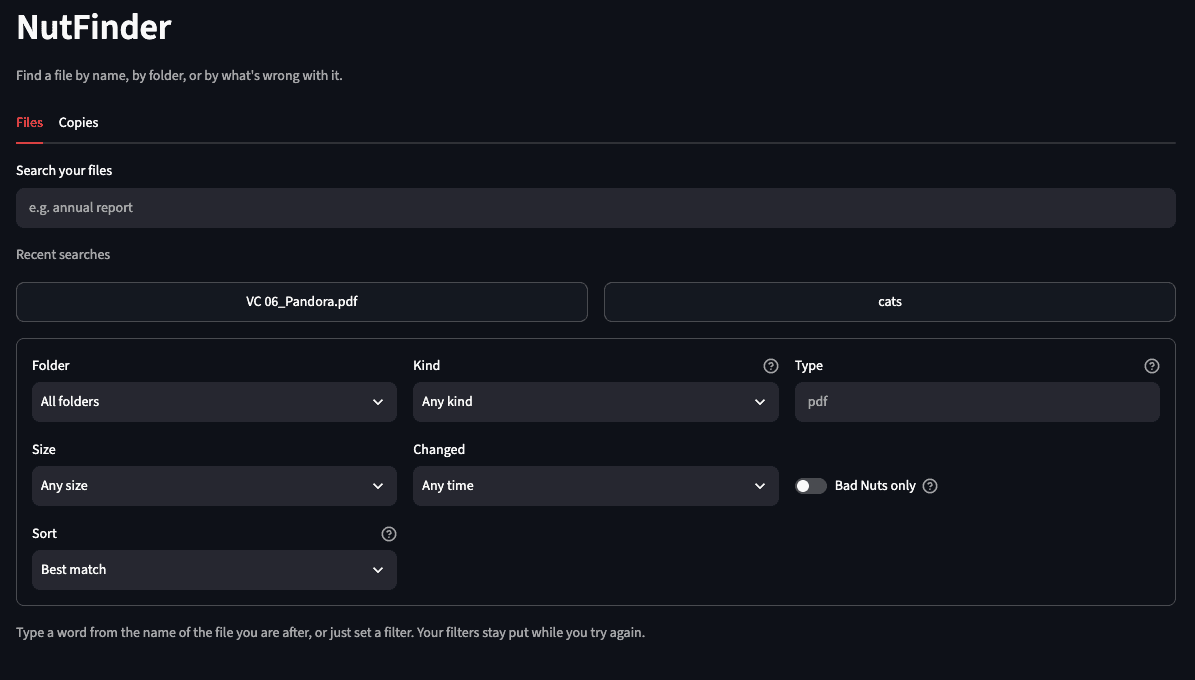
DataSquirrel
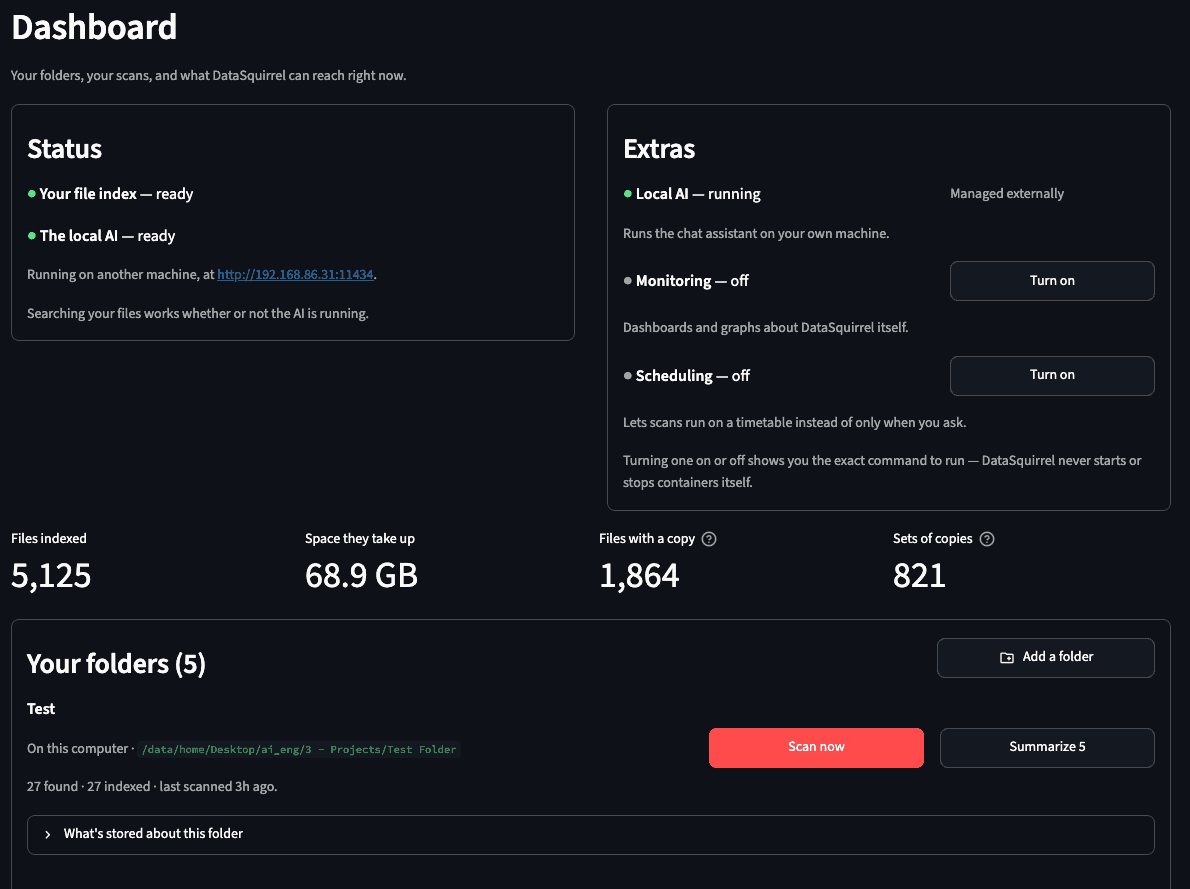
DataSquirrel is self-hosted file intelligence: it indexes the storage you point it at — local folders, NAS mounts and Google Drive — and then lets you find anything in it, without a single byte leaving your machine.
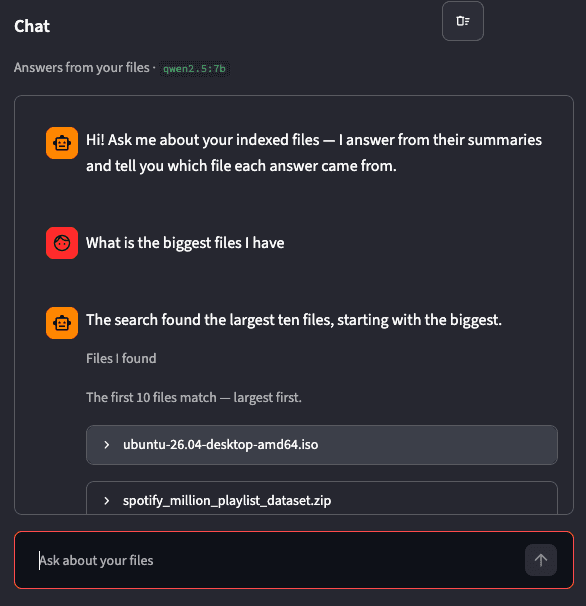
Point it at a folder and it crawls, hashes and catalogues every file it finds. From there, NutFinder searches by name and metadata and narrows results by folder, kind, file type, size or date; a duplicate report shows what you are storing more than once; a storage breakdown shows where the disk actually went. On request — never automatically — a local LLM reads and summarizes a file, a selection or a whole folder, and those summaries become searchable alongside filenames. A chat assistant in the sidebar answers questions about your files from those summaries, cites the files it used so you can click straight through to them, and can run a filtered search itself: ask for your largest videos from this year and it works out the filters. When a file changes, its summary is flagged as outdated rather than silently rewritten; when a file disappears, DataSquirrel tells you instead of handing you a dead path.
Everything runs in Docker on your own hardware: a FastAPI service and a Streamlit interface over PostgreSQL 16 with full-text search and pgvector, with Ollama serving the model. No cloud service, no account, no telemetry. One codebase runs as a four-container install on a laptop or, by configuration alone, adds GPU inference, scheduled scans and monitoring — topology is a deployment choice, never a separate code path.
Personal and household storage sprawls across laptops, external drives, a NAS and cloud accounts — and the tools that search it well are the ones that require uploading it first. DataSquirrel's goal is to give people that same quality of search over storage they control: filename and metadata search, on-demand content summaries, and a chat assistant that answers with citations, all on hardware they own, with no account and no data leaving the machine. The second goal is architectural — one codebase that installs as four containers on a laptop and scales to GPU inference, scheduled scans and monitoring purely by deployment configuration, never by branching code.
The Team
- Beatrice
Bea built the structured logging, the PostgreSQL integration test harness and the duplicate review view.
- Arsalan
Arsalan built the backend spine — the FastAPI service, the ingestion pipeline and the orchestration seam.
- Saschsa
Sascha built the interface: the app shell, the Dashboard, NutFinder itself, plus the deduplication engine and the Google Drive connector.
- Niall
Niall led the architecture and the content-intelligence layer — the database schema, the full-text search behind NutFinder, and the chat assistant that cites the files it answers from.
We AI-proof
your career


