
Education voucher webinar
The German Education Voucher: How To Get Your Fully Funded Tech CourseJun 18, 2026
Are you ready to get started in the world of IT? Find out all about financing bootcamps in our info session on education vouchers.
Education voucher at hand? Step into the fast lane: Contact us
Contact usYour bootcamp




Keyfacts
Tech Stack
➡️ Perfect for beginners and career changers: You do not need any background in IT or security. We will help you leverage your existing professional experience as a strength and prepare you for roles at the intersection of technology, regulation, and strategy.
➡️ It doesn't matter if you live in Berlin, Hamburg, North Rhine-Westphalia, Bavaria, Hesse or any other place in Germany, you can do this Bootcamp Online. So then, what are you waiting for?
➡️ Highly In-Demand All-Round Knowledge: Master the core pillars of IT security – from technical fundamentals and cloud security to AI defense, GRC, and compliance.
➡️ Intense Practical Focus: Learn to work like a real analyst directly on the system through 259 hands-on labs in a live VDI environment using industry-standard tools like Splunk.
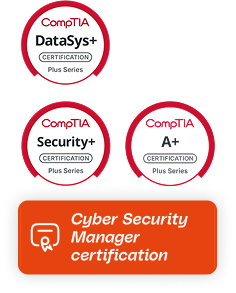
➡️ Four Top Certifications: Receive intensive preparation for four globally recognized CompTIA certifications and create real, employer-ready deliverables in your capstone project.
✅ Crisis-Proof Future Career: Leverage your skills in a booming market. New regulations like NIS2 and the rapid rise of AI are driving an unprecedented demand for security professionals.
✅ High-Value Bridge Role: Upon graduation, you will seamlessly connect deep technical security knowledge with the legal compliance reality (ISO 27001, GDPR) of German and European enterprises.
Our partner companies
Starting dates
Jul | 20th Jul – 20th Nov ‘26 | Full-Time | Remote | English | Secure seat |
|---|
Curriculum
You cannot protect what you do not understand. Phase 1 builds the essential technical foundation for your security career while developing the diagnostic mindset of a real incident responder. Through a structured troubleshooting approach, you will learn to think like an analyst from day one.
What you master:
Hardware & Architecture: Understanding what you defend at the physical layer, from CPUs to motherboards.
OS Administration: Windows and Linux skills that underpin forensic investigation, permissions, and malware analysis.
Troubleshooting Methodology: Structured problem diagnosis, isolating variables, and testing hypotheses.
Data & Interfaces: Crucial context for forensic work, data classification, and system movement.
Documentation & Awareness: Developing clear, structured writing and a security mindset from the very beginning.
Lab focus: 57 hands-on hardware and troubleshooting labs across the first two phases. This includes your first unassisted diagnostic sessions with real virtual machines and real faults, but no instructions.
Most cybersecurity incidents today move through cloud-connected infrastructure. Understanding modern physical, virtual, and cloud environments is not just background knowledge – it is your map to trace attacks and identify exactly what does not belong.
What you master:
Networking Fundamentals: Protocols like TCP/IP, DNS, and HTTP analyzed from the command line to trace packets and spot anomalies.
Virtualisation Concepts: Hypervisors, containers, and VMs, along with security risks like VM escapes and isolation strategies.
Cloud Computing Models: IaaS, PaaS, SaaS, and the shared responsibility model that serves as the foundation for your future GRC work.
Mobile Device Management: BYOD security policies and mobile data protection, directly relevant to GDPR compliance in the workplace.
Git & GitHub: Version control for security scripts, Infrastructure as Code, and modern DevSecOps environments.
Security Awareness: Best practices and the human factor as the cornerstone of a strong security culture from day one.
Lab focus: Continued hardware labs plus 31 specialized operating systems labs. Your VDI sessions include real cloud console navigation and virtualisation configuration.
The network is your operating environment as an analyst. Whether you are working in a SOC, conducting vulnerability assessments, or advising on NIS2 compliance, you must read network traffic, understand normal protocol behavior, and spot anomalies immediately. Phase 3 makes you completely fluent in this language.
What you master:
OSI Model & Network Analysis: Mapping attacks to OSI layers, plus packet inspection and port scanning using real capture files.
IP Addressing & Segmentation: Subnetting to prevent lateral movement of attackers across overly flat networks.
Identity & Access Control: Attacking and defending passwords, MFA, certificates, and Single Sign-On.
Wireless & Remote Security: WPA3, rogue access point detection, VPN configurations, and modern Zero Trust Network Access (ZTNA).
Network Hardening & Firewalls: Reducing attack surfaces through firewall rules, traffic filtering, and least-privilege principles.
Cloud Security Introduction: Practicing the shared responsibility model and debunking compliance misconceptions regarding AWS or Azure.
Lab focus: 82 networking and connectivity labs – the largest lab category in the program, reflecting how critical and transferable network analysis is across all cybersecurity roles.
Phase 4 is the most intensive phase of the program and provides your clearest career differentiation. Here, you connect your technical skills with the regulatory reality in Germany, dive deep into AI security, and pass the CompTIA Security+ examination. This unique combination of certification, hands-on GRC, ISO 27001, IT law, and AI security is unmatched.
What you master:
Security Analysis & Incident Response
Threat Intelligence & Risk Assessment: Profiling attackers and tracking their tactics using intelligence frameworks.
Cryptography & Forensics: Implementing encryption in line with GDPR and ISO 27001, and mastering the 6-phase incident response process including evidence collection.
IAM & Detection Systems: Managing identity and access control as a critical success factor, alongside deploying and tuning IDS/IPS systems.
Log Analysis & Threat Hunting: Conducting proactive threat hunting and alert investigations using tools like Splunk, ELK Stack, and Microsoft Sentinel.
AI in Cybersecurity
The Evolving Attack Surface: Understanding AI as a tool for both defenders and attackers, and securing models, prompts, and APIs against manipulation.
AI-Assisted Operations: Automating reports and log summaries while ensuring the responsible use of AI tools.
AI Governance & Incident Response: Managing risk assessment, compliance concerns, and responding to AI-specific security incidents.
GRC Fundamentals & IT Law
Risk Management & ISO 27001: Governing the full risk lifecycle and building, managing, and auditing an Information Security Management System (ISMS) to international standards.
BSI-IT-Grundschutz: Mastering Germany's national security framework – a genuine differentiator in the local job market.
German & EU Cybersecurity Law: Successfully implementing compliance requirements under GDPR (including the 72-hour breach notification window) and the NIS2 Directive (security measures and BSI reporting timelines).
Governance & Works Councils: Writing compliant security policies while navigating the co-determination rights of German Works Councils when deploying security tools.
Lab focus: 58 Compliance & Security Framework labs. You write policies, build risk registers, and prepare audit evidence – the exact outputs of a GRC Analyst's working week.
Phase 5 elevates your capabilities to analyst-level. You will tackle complex, real-world scenarios across cloud environments, web applications, and multi-vector attack simulations using industry-standard tools. This phase directly builds the advanced expertise certified by CompTIA CySA+ and completes your AI in Cybersecurity track.
What you master:
Advanced Security Analysis
Advanced Threat Intelligence & EDR: Deep-dive attacker profiling and endpoint threat hunting, correlating telemetry with SIEM platforms like Splunk and Sentinel.
Vulnerability Management & OWASP Top 10: Scanning networks and cloud environments, calculating CVSS scores, and conducting controlled exploitation against web application flaws.
Red vs. Blue Team Methodologies: Experiencing structured offensive and defensive exercises to build a complete, dual-perspective security mindset.
Automation & Remediation Strategy: Writing scripts to automate scanning workflows and drafting professional vulnerability reports with clear, prioritized fixing plans.
AI in Cybersecurity
EU AI Act & Governance: Integrating AI risk assessments into ISO 27001 and NIS2 compliance programs, while navigating legal obligations for high-risk AI.
AI-Powered SOC & Production Automation: Operating with AI-driven first-pass triage, building automated reporting pipelines, and managing AI-enhanced threat hunting.
AI Incident Response: Defending against attacks targeting AI systems, such as prompt injection and model poisoning, as well as AI-generated malware.
Advanced Cloud Security
Cloud Scanning & Zero Trust: Spotting misconfigurations and over-permissioned IAM roles in AWS and Azure, while applying Zero Trust principles to meet NIS2 requirements.
Infrastructure as Code (IaC) Security: Securing configurations within the CI/CD pipeline before they deploy to production.
Cloud Incident Response: Conducting investigations using cloud-native logs and mastering evidence preservation in ephemeral environments.
Lab focus: 25 Cybersecurity Analysis labs, 6 Cloud & Virtualization labs, and advanced SIEM scenarios. This phase features the highest concentration of unassisted diagnostic sessions, forcing you to solve real issues without a safety net.
The capstone is your professional portfolio – the tangible evidence you present to employers and discuss in interviews. It is structured to produce the exact deliverables that hiring managers in security operations, GRC, and cloud security are actually looking for.
What you produce:
Security Assessment Report: A structured vulnerability assessment of a target environment. Findings are risk-rated using CVSS and translated into a prioritized remediation plan ready for senior management.
GRC Documentation Package: A core set of security policies tailored to an organizational scenario. It includes a risk register and demonstrates exactly how the controls satisfy GDPR and ISO 27001 requirements.
AI Security Risk Assessment: A structured analysis of an enterprise AI system. You will identify data, misuse, and supply chain risks, and document the required controls and governance decisions in line with the EU AI Act.
Final Presentation: A 20-minute briefing and Q&A session before a panel. This mirrors real-world executive briefings and sharpens your communication skills under pressure.
The context: Capstone scenarios are grounded in the German business landscape – whether a Mittelstand manufacturer, a healthcare provider, or a financial services firm. Your entire project aligns directly with the regulatory and operational realities (GDPR, NIS2, ISO 27001) you will encounter on the job.
Assessment criteria:
Technical accuracy and depth of the security assessment
Quality, completeness, and compliance-readiness of the GRC documentation
Depth and practicality of the AI risk analysis
Clarity, structure, and professional quality of the final presentation and Q&A
Education must be affordable. Check out all the financing options now.

In order to receive your education voucher for your retraining from the employment agency, the Jobcenter or the Labour Office, you should register as a jobseeker at an early stage. It is therefore very important that you first make an appointment with the relevant office. It's best to do it now!
The next step on the way to your IT training voucher is quick and easy: Contact us! We will create an official training offer for you that you can then submit to the employment agency, the Jobcenter or the employment office.
Now it's down to the nitty-gritty: With the training offer we have created, you now go back to your responsible office and apply for your training voucher. As soon as it is approved, you can start your new career with us. We look forward to seeing you!

Career Service
Our career service helps you turn your new skills into your next role with CV reviews, LinkedIn feedback, and interview coaching.
➡️ Structured job search support through our career program.
➡️ Weekly Q&A support and feedback in our Discord channels.
➡️ Community access for networking.
FAQ
Yes. If you are registered as a jobseeker or at risk of unemployment, you may be eligible for a Bildungsgutschein (education voucher) that covers the full cost of the programme.
The process involves three steps: registering as a jobseeker with your local Agentur für Arbeit or Jobcenter, requesting our official training documentation (we provide this within one working day), and submitting the voucher application. Approval typically takes two to six weeks — cohort sizes are limited to approximately 15 participants, so starting early matters.
Contact us at studienberatung@neuefische.de or +49 30 9173 9346. We will walk you through the process.
No. The programme is designed to take you from foundational IT knowledge to job-ready cybersecurity skills in 16 weeks. Phase 1 begins with how computer systems work and structured troubleshooting — no prior technical knowledge assumed. Career changers from non-technical backgrounds make up a significant part of every cohort.
The 259 structured hands-on labs and two dedicated coaches per cohort are specifically designed to build confidence and capability from wherever you start.
Germany currently has over 104,000 unfilled cybersecurity roles, and the Bundesagentur für Arbeit approves Bildungsgutschein funding for training that is demonstrably labour-market relevant. Cybersecurity meets that test comprehensively.
Germany's NIS2 implementation came into force in December 2025, creating mandatory security obligations for approximately 29,000 organisations that previously had no formal cybersecurity requirements. These organisations need qualified professionals immediately. ISO 27001, GDPR, and NIS2 compliance skills are now explicitly recognised as shortage-area qualifications — which strengthens the case when speaking with your counsellor.
The programme runs Monday to Friday, 9:00–18:30 — approximately 47.5 structured hours per week. This is a full-time commitment equivalent in time to a full-time job. The intensity is deliberate: 16 weeks of full-time study compresses a qualification that would take 18–24 months of self-study into a programme that gets you job-ready quickly.
A typical week includes instructor-led sessions in the morning, hands-on lab work in the afternoon, and structured exercises or peer collaboration in the later session. Certification study requires consistent additional effort outside structured hours.
200+ labs means 200+ separate hands-on exercises on real Virtual Infrastructure — not simulated click-throughs or screen-recorded demos. Each lab is a real task in a real environment, using the actual tools used in professional security operations.
The breakdown: 80+ labs in Networking & Connectivity, 50+ in Compliance & Security Frameworks, 50+ in Hardware & Troubleshooting, 30+ in Operating Systems, 25+ in Cybersecurity Analysis, and 10+ in Cloud & Virtualisation. The labs also include unassisted diagnostic sessions — see the next question.
200+ labs = 200+ opportunities to practise before your first day on the job.
The four certifications (A+ Core 1, A+ Core 2, Security+, CySA+) follow a deliberate progressive structure: each builds on the previous one, and certification preparation is woven into the content rather than treated as a separate study stream.
A+ Core 2 is examined at the end of Phase 1, A+ Core 1 at the end of Phase 2 — while the hardware and networking content is current. Security+ is examined at the end of Phase 4 after 9 weeks of progressively deeper security content. CySA+ is examined at the end of Phase 5 after analyst-level skills have been developed across multiple lab scenarios.


